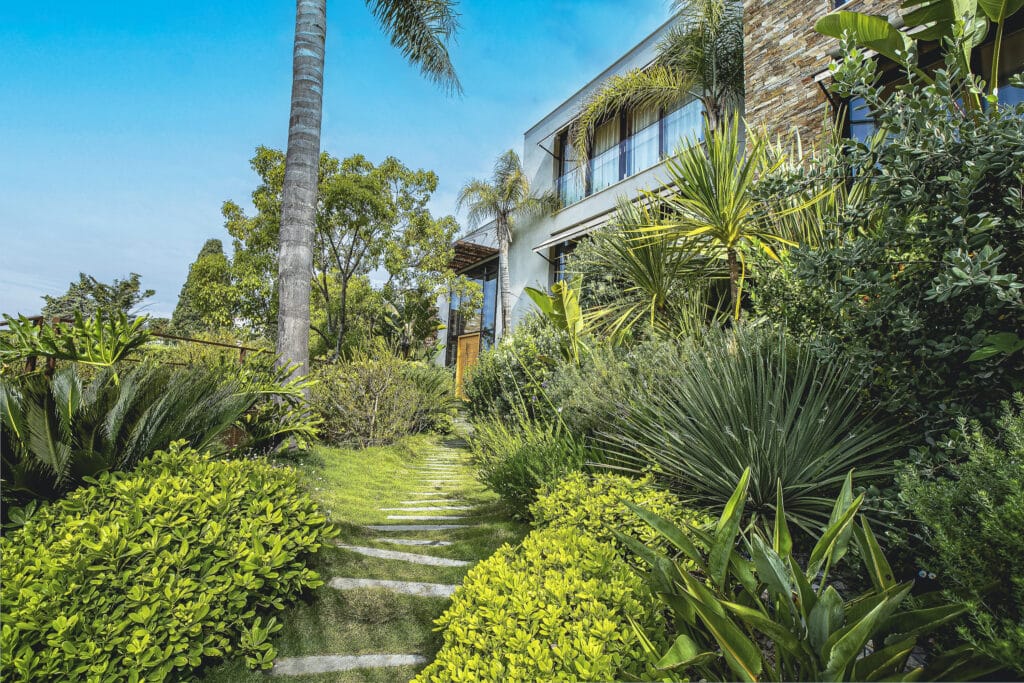
A contemporary villa deserves a landscape setting worthy of its stature. Modern architecture with clean lines and noble materials blends seamlessly with its environment. The garden becomes a natural extension of the contemporary villa, with landscape design that enhances its character and showcases every view. But how can one create a garden that aligns with the aesthetic codes of contemporary architecture while maintaining elegance and functionality?
The aesthetic codes of the contemporary villa
Contemporary architecture is defined by its pursuit of simplicity and purity. Clean lines prevail, volumes respond to each other with precision, creating a balanced composition where every element has its place. Noble materials are key:
- Glass for transparency and light
- Concrete for strength and sobriety
- Wood for natural warmth
- Metal for industrial elegance
This approach is based on harmony between interior and exterior. The garden mirrors the lines of the villa and is arranged according to the views from within the house. Every opening frames a landscape designed as a natural backdrop, creating continuity that links the spaces and reinforces the sense of openness and flow.
Core principles of contemporary landscape design
Contemporary landscape design revolves around a few fundamentals that shape the garden’s identity.
Minimalism and geometry
Less is more—this saying sums up the contemporary garden approach. Quality is favored over abundance, and the visual impact of a well-chosen feature takes precedence over scattered accumulation. Geometry structures the space with straight paths, beds with defined edges, and rectangular water features. These clean shapes echo the villa’s architecture.
Spatial structuring
The contemporary garden is divided into distinct yet interconnected zones: terrace, relaxation area, pool space, and a discreet aromatic garden. Each zone serves its own purpose while contributing to the overall harmony. Transitions between these areas are marked by changes in ground material, green screens, or low walls that define the spaces without enclosing them.
To ensure all key steps of a successful layout are respected, a phase of spatial structuring is essential to guarantee fluidity and coherence.
A plant palette as a graphic language
Which plants best embody the contemporary spirit?
Structural and expressive plants
The contemporary garden relies on a curated and controlled plant selection:
- Understated and graphic species to structure the space;
- rare tree species suited to the Mediterranean climate to create a distinctive plant signature and enhance the architectural character of the garden;
- Ornamental grasses for softness and movement;
- Geometrically pruned boxwood for rhythm;
- Sculptural olive trees with silvery foliage;
- Clumping bamboos and architectural palms to create strong vertical lines.
Shaping plants becomes an art form in this kind of layout: modern topiary, cloud pruning, abstract shapes… The gardener’s hand shapes the living to interact with the architecture.
Contrast and repetition as design tools
Contemporary aesthetics also rely on bold yet simple choices:
- Contrast between fine foliage and broad glossy leaves
- Juxtaposition of textures—smooth surfaces and rougher bark
- Mass planting, emphasizing large homogeneous groupings
These principles guide the eye and structure the space. Generous clusters of grasses or lavender increase visual impact, foster unity, and highlight the garden’s lines. Repetition brings balance and clarity while reinforcing a distinctly contemporary aesthetic.
Materials and furniture: extending architecture outdoors
Materials and furniture play a key role in the garden’s aesthetic, extending the villa’s architectural style.
Surface finishes
Terraces feature noble materials that continue the villa’s design spirit:
Exotic or composite wood: natural warmth, comfortable under bare feet
Polished or waxed concrete: ultimate modernity, customizable tones, seamless surface
Natural stone: travertine, granite, or slate for a timeless yet modern grounding
Large-format porcelain stoneware: perfect imitation of natural materials, optimal durability
Contemporary furniture
Furniture follows the same commitment to simplicity. Clean lines, durable materials, comfort without ostentation. Powder-coated aluminum, teak, and high-quality woven resins are preferred. Colors remain neutral (white, anthracite grey, black, beige), with occasional colorful accents used sparingly to enliven the ensemble.
Lighting: the garden’s nocturnal signature
At nightfall, the garden reveals another side of its personality through well-considered lighting. The golden rule: illuminate without dazzling. Indirect lighting envelops the space, creating a warm, understated atmosphere.
Key principles structure this lighting design:
- Highlight without excess: recessed spots to reveal a tree or green wall, discreet projectors to enhance material textures
- Guide eyes and movement: LED strips under benches or along steps, low bollards lining paths without breaking perspective
- Shape the volumes: light lines outlining a pool, shadow and light contrasts to establish spatial hierarchy
Lighting isn’t just about visibility—it defines function and ambiance. Functional for dining, soft for intimate evenings, dramatic for events, lighting is now precisely controllable thanks to smart systems.
Contemporary inspirations and landscape trends
Current trends in luxury landscape design highlight several aesthetic directions. A well-balanced project combines Mediterranean vegetation with contemporary design: century-old olive trees, graphic lavender, and water features with clean lines. This fusion of local tradition and international modernity creates a unique signature—rooted in its environment while embracing global luxury standards; an approach that fully aligns with the vision of a sustainable garden designed to stand the test of time.
The high-end dry garden, combining environmental responsibility with contemporary aesthetics, has become an essential approach for bringing together elegance and water efficiency in landscape design projects. Mineral and plant elements are balanced; gravel replaces thirsty lawns, and succulents form graphic compositions. This approach addresses today’s climate challenges without sacrificing elegance.
Get inspired with our article on the most beautiful luxury garden styles inspired by the Riviera.
A contemporary garden isn’t improvised. It must be conceived as an extension of the architecture, where every choice (materials, lines, plants, lighting) contributes to a thoughtful and lasting composition. A refined outdoor space, built to endure. Entrust your project to our expert landscape designers. Together, let’s give your villa a garden that lives up to its architecture.